
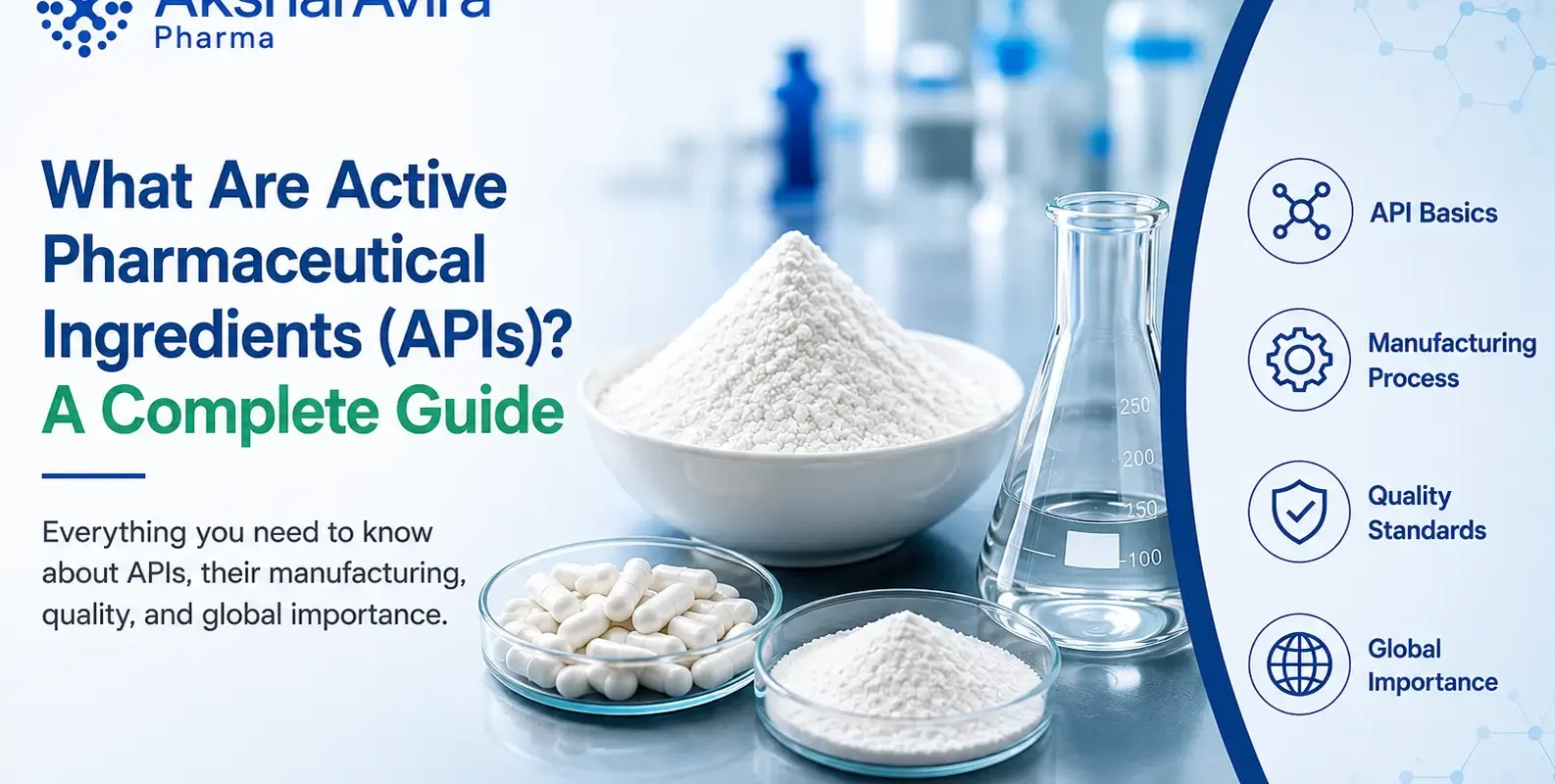
Every medicine contains one component that actually does the work. Active Pharmaceutical Ingredients are the chemical or biological substances in a drug product that produce the intended effect on the body.
Everything else in the tablet, capsule, or injection exists to deliver that substance safely. The binder, the coating, the colour — none of it treats anything.
The API is also the most expensive input in most medicines, the hardest to source reliably, and the part regulators scrutinise most closely.
This guide covers what an API is, how it is made, what standards apply, how impurities and physical form are controlled, and what buyers check before ordering.
Quick answer: An Active Pharmaceutical Ingredient (API) is the biologically active substance in a medicine that produces its therapeutic effect. It is manufactured separately from the finished dosage form, tested against pharmacopoeial standards such as USP, BP, EP, or IP, and controlled for purity, impurities, and physical properties before formulation.
Table of Contents
- What Are Active Pharmaceutical Ingredients?
- API vs Excipient: The Two Halves of Every Medicine
- How Active Pharmaceutical Ingredients Are Manufactured
- API Grades and Pharmacopoeial Standards
- Polymorphism and Particle Size: Why Physical Form Matters
- Impurities and Related Substances
- Why API Quality Decides Finished Drug Quality
- How Active Pharmaceutical Ingredients Are Regulated
- What Buyers Evaluate When Sourcing APIs
- Expert Tips
- Common Mistakes
- Frequently Asked Questions
What Are Active Pharmaceutical Ingredients?
An Active Pharmaceutical Ingredient is the substance in a medicine responsible for its pharmacological action — the component intended to treat, prevent, or diagnose a disease.
You will also hear drug substance, bulk drug, and API used for the same thing. Drug substance is the common term in regulatory filings; bulk drug is used widely in India and parts of Asia.
An API arrives as a powder, crystal, granule, or liquid in drums or bags. It is not a medicine yet. A formulation plant converts it into tablets, capsules, syrups, or injections.
A simple example
A 500 mg paracetamol tablet contains 500 mg of paracetamol API, but the tablet may weigh 600 mg or more. The extra weight is excipients — starch, povidone, magnesium stearate, and coating. For the full comparison, see our guide on API vs Finished Dosage Form.
API vs Excipient: The Two Halves of Every Medicine
Every drug product is built from actives and non-actives. The two are priced, tested, and regulated on different terms, so confusing them causes real procurement problems.
| Aspect | Active Pharmaceutical Ingredient | Excipient |
|---|---|---|
| Function | Produces the therapeutic effect | Delivers, stabilises, or shapes the product |
| Examples | Paracetamol, metformin, amoxicillin | Lactose, starch, magnesium stearate, titanium dioxide |
| Quantity per unit | Fixed by label strength | Varies with formulation design |
| Typical cost share | Usually the largest single cost | Usually a small share of cost |
| Regulatory filing | DMF, CEP, or equivalent dossier | Supplier COA and compendial compliance |
| Testing depth | Assay, related substances, residual solvents, polymorphic form | Identity, purity, functional tests |
| Change control | A source change often needs regulatory approval | Often lower impact, but still controlled |
Excipients still matter — a poor grade of lactose can wreck tablet hardness. But the API is what regulators tie directly to safety, which is why switching API suppliers is a regulatory event in most markets and switching a magnesium stearate supplier usually is not.
How Active Pharmaceutical Ingredients Are Manufactured
APIs are made by four broad routes. The route determines cost, scale, impurity profile, and how tightly the process must be controlled.
1. Chemical synthesis
Most small-molecule APIs are made this way, through a sequence of reactions, each followed by isolation, purification, or crystallisation.
Regulators focus on the stages after the regulatory starting material, because those steps determine the impurity profile and physical form of the substance.
Paracetamol, metformin, and atorvastatin come from synthetic routes. Solvent choice and catalyst residues become quality attributes you later see on a COA.
2. Fermentation
Some APIs are produced by microorganisms grown under controlled conditions. Penicillins, cephalosporins, several statins, and immunosuppressants start life in fermentation tanks.
The output is extracted, purified, and often chemically modified afterwards — a hybrid route called semi-synthesis, of which amoxicillin is a familiar product.
Fermentation carries biological variability, so consistency depends on strain control, media quality, and contamination prevention.
3. Biotechnology and recombinant processes
Large-molecule APIs — insulin, monoclonal antibodies, hormones, and enzymes — are produced in living cell systems such as bacteria, yeast, or mammalian cell lines.
These cannot be defined by chemical structure alone, so the process itself becomes part of the specification. Most also need cold chain handling, covered in our article on temperature-controlled pharmaceutical logistics.
4. Plant and natural extraction
Certain APIs are isolated from botanical or animal sources — digoxin, atropine, morphine, and several alkaloids fall into this group.
Extraction faces a problem the other routes do not: raw material variability. Growing region, harvest season, and drying method all shift yield and impurity pattern.
API Grades and Pharmacopoeial Standards
An API is only meaningful when tied to a standard. “99% pure” tells a buyer almost nothing; what matters is which pharmacopoeial monograph the material meets. A pharmacopoeia is a legally recognised book of standards, and each monograph lists the tests, methods, and limits for a named substance.
The main pharmacopoeias
| Pharmacopoeia | Abbreviation | Region of legal force |
|---|---|---|
| United States Pharmacopeia | USP | United States |
| British Pharmacopoeia | BP | United Kingdom and several Commonwealth markets |
| European Pharmacopoeia | EP / Ph. Eur. | European Union and EDQM member states |
| Indian Pharmacopoeia | IP | India |
| Japanese Pharmacopoeia | JP | Japan |
Monographs for the same molecule are similar but not identical. Limits for a related substance, the analytical method, or the residual solvent list can differ between USP and EP.
So a purchase order must state the grade. “Metformin Hydrochloride USP” and “Metformin Hydrochloride EP” are different commercial products, even though the molecule is the same.
Where no monograph exists, manufacturers use a justified in-house specification. Be cautious with technical, food, or cosmetic grade material offered cheaply — it is not pharmaceutical grade and must never enter a medicinal product.
Polymorphism and Particle Size: Why Physical Form Matters
Two batches can have identical chemical purity and still behave completely differently in a tablet press. Physical form is the reason.
Polymorphism
Many solid APIs crystallise into more than one internal arrangement. These forms are called polymorphs, and they share a chemical formula but differ in melting point, stability, and solubility.
Different solubility means different dissolution, and dissolution influences how much drug becomes available in the body. So the polymorphic form is often a registered attribute.
Some APIs also exist as hydrates, solvates, or amorphous material. An amorphous form may dissolve faster but convert to a crystalline form over shelf life — a known cause of stability failures.
Particle size distribution
Particle size affects dissolution rate, flow, blend uniformity, and compressibility. A micronised grade and a standard grade of the same API can perform very differently.
For low-dose products, particle size drives content uniformity. Coarse particles can make individual tablets vary in strength even when the overall blend is correct. Specify the grade you need and ask for particle size data (typically D10, D50, D90) on the COA.
Impurities and Related Substances
No API is completely pure. Regulators do not expect purity; they expect impurities to be identified, quantified, and controlled within justified limits.
Categories of impurity
Organic impurities include unreacted starting materials, intermediates, by-products, and degradation products. These appear on a COA as “related substances” with individual and total limits.
Inorganic impurities cover residual catalysts, reagents, heavy metals, and salts, controlled under ICH Q3D principles in regulated markets.
Residual solvents are the solvents left from processing. ICH Q3C sorts them into three classes, with Class 1 solvents such as benzene effectively prohibited.
Genotoxic and nitrosamine impurities carry the tightest limits because they may damage DNA at very low levels. Nitrosamine risk assessment is now a standard requirement.
How limits are set
Impurity control follows threshold logic: reporting, identification, and qualification thresholds. Below the first, an impurity need not be listed. Above the last, its safety needs data.
A COA showing only “assay 99.5%” tells you something about that supplier’s quality system. See our Certificate of Analysis guide.
Why API Quality Decides Finished Drug Quality
Formulation cannot fix a bad API. This is the single most useful thing a new buyer can learn.
If the polymorph is wrong, dissolution fails. If particle size drifts, content uniformity fails. If an unknown impurity appears, the batch fails specification and the investigation is expensive.
Stability is the slower failure mode. An API carrying degradation-prone impurities may pass release testing and then fail at the 6-month station, by which time product is in the market. See Understanding Stability Studies in Pharmaceuticals.
Documentation is the third risk. If your supplier cannot provide the regulatory support your market needs, registration stalls however good the material is.
How Active Pharmaceutical Ingredients Are Regulated
APIs are regulated separately from finished products. The manufacturer must operate to GMP for APIs, and the manufacturing process must be filed with the relevant authority.
Drug Master File (DMF)
A DMF is a confidential dossier submitted to an authority describing the facility, process, controls, and specifications for an API. It lets a manufacturer share proprietary detail with the regulator without disclosing it to the customer.
The customer receives a Letter of Access allowing the authority to review the DMF. The US FDA operates Type II DMFs; the EU uses the Active Substance Master File. Our Drug Master File explained article covers the mechanics.
Certificate of Suitability (CEP)
A CEP is issued by the EDQM and confirms that an API made by a specific route at a specific site complies with the relevant European Pharmacopoeia monograph. It simplifies EU submissions and is a strong quality signal when evaluating a supplier.
Written Confirmation
APIs imported into the European Union must generally carry a Written Confirmation from the authority of the exporting country, confirming the site is inspected and applies GMP standards equivalent to EU requirements. Countries on the EU equivalence list are exempt; exporters elsewhere must obtain the document before shipment.
GMP for APIs
ICH Q7 is the recognised GMP guideline for active substances, covering facilities, equipment, materials management, process controls, validation, and change control. Authorities enforce it under different names and inspection regimes — see our comparison of GMP, WHO-GMP, EU GMP and US FDA.
What Buyers Evaluate When Sourcing APIs
Price is the easiest number to compare and the least useful on its own. Experienced buyers work through a wider checklist before discussing cost.
Regulatory readiness. Does the supplier hold a DMF, CEP, or equivalent for your market, and is the site inspected by an authority your regulator recognises?
Quality documentation. Ask for a specimen COA, full specification, method details, stability data, and impurity profile. A supplier who hesitates here will hesitate when you have a problem.
Manufacturing capability. Confirm the material is made at the site named on the offer, not traded from an unnamed source.
Supply continuity. Check where the key starting materials come from. Many API supply failures start two steps upstream, not at the API plant.
Commercial fit. Confirm minimum order quantity, packaging, retest date, and shipping conditions — see pharmaceutical export documentation.
For a full evaluation framework, see what buyers should check before choosing an API supplier.
Expert Tips
- Order a pilot quantity before a full campaign. Run it through your own methods. Paper specifications and press behaviour are not the same thing.
- Ask for three consecutive batch COAs, not one. One shows compliance. Three show consistency, and consistency is what you are buying.
- Write polymorphic form and particle size into the purchase specification. If it is not on the PO, you cannot reject material that meets assay but fails in your process.
- Qualify a second source before you need it. Adding an alternate supplier takes months of regulatory work. Starting during a supply interruption is too late.
- Agree change notification in writing at contract stage. The supplier should tell you before any change to route, site, specification, or starting material source.
Common Mistakes
- Buying on price per kilogram alone. A cheap API with a difficult impurity profile costs more in failed batches than it saved on purchase.
- Not specifying the pharmacopoeial grade on the order. You may receive IP material when your dossier requires EP, making the batch unusable.
- Accepting a COA without the related substances section. You lose sight of the impurity profile and find the problem during stability testing, not at release.
- Assuming one GMP certificate satisfies every market. Each authority has its own recognition rules, so an unrecognised certificate stalls your application.
- Changing API source without assessing regulatory impact. In most markets this triggers a variation, and shipping from an unapproved source is a compliance breach.
Frequently Asked Questions
What are Active Pharmaceutical Ingredients in simple terms?
Active Pharmaceutical Ingredients are the substances in a medicine that produce the therapeutic effect. In a 500 mg paracetamol tablet, paracetamol is the API and everything else supports its delivery. APIs are made in dedicated facilities and supplied as powders, crystals, or liquids in bulk. A formulation plant converts them into tablets, capsules, or injections, and they must meet pharmacopoeial standards before use.
What is the difference between an API and a drug product?
An API is the raw active substance. A drug product, or finished dosage form, is the packaged medicine a patient takes. The API is one input into that product, combined with excipients and processed into a tablet, capsule, syrup, or injection. They are regulated differently too: the API sits under a Drug Master File, while the drug product needs a marketing authorisation in each market.
How are Active Pharmaceutical Ingredients manufactured?
There are four main routes. Chemical synthesis builds the molecule through a sequence of reactions and covers most small-molecule drugs. Fermentation uses microorganisms and produces many antibiotics and statins. Biotechnology uses engineered cell lines for large molecules such as insulin and monoclonal antibodies. Plant or animal extraction isolates the substance from natural sources. The route shapes impurity profile, cost, scale, and the process control regulators expect.
What does USP, BP, EP, and IP grade mean for an API?
These name the pharmacopoeia the material complies with: United States, British, European, and Indian. Each publishes a monograph listing required tests, analytical methods, and acceptance limits. Monographs for the same molecule are similar but not identical, so limits and methods can differ. State the required grade on your purchase order, because material meeting one pharmacopoeia may not satisfy another market’s dossier requirements.
Why does polymorphism matter when buying an API?
Polymorphs are different crystal forms of the same molecule. They share a chemical formula but differ in melting point, stability, and solubility. Solubility affects dissolution, and dissolution affects how the drug behaves in the body, so the form is often a registered specification. Receiving a polymorph other than the one your dossier states can cause dissolution failures. Specify the form on purchase documents and confirm it appears on the COA.
What is a Drug Master File and do I need one?
A Drug Master File is a confidential dossier the API manufacturer submits to a regulatory authority, describing the facility, process, controls, and specifications. As a buyer you do not file it, but you need a Letter of Access so the authority can review it alongside your application. Whether one is needed depends on the market — regulated markets require a DMF, Active Substance Master File, or CEP.
What is a Written Confirmation for API export?
A Written Confirmation is issued by the competent authority of an exporting country. It confirms the API manufacturing site is inspected and applies GMP standards at least equivalent to European Union requirements. It is generally required for APIs imported into the EU, unless the exporting country is on the EU equivalence list. Arrange it well before shipment, because it takes time and shipments can be held without it.
How do I verify the quality of an API supplier?
Start with documents: DMF or CEP status, GMP certificates, inspection history, specimen COA, full specification, and stability data. Verify the manufacturing site is the one named on the offer and not an undisclosed third party. Request three consecutive batch certificates to check consistency rather than a single result. Where volumes justify it, arrange an audit. Finally, run a pilot quantity through your own methods.
What impurities are controlled in an API?
Four groups. Organic impurities cover starting materials, intermediates, by-products, and degradation products, reported as related substances. Inorganic impurities include residual catalysts, reagents, and elemental impurities. Residual solvents are the processing solvents left in the material, classified by risk. Genotoxic and nitrosamine impurities carry the tightest limits because they can harm at very low levels. A proper COA reports individual and total related substances, not one assay figure.
Are API and bulk drug the same thing?
Yes, in practice. Active Pharmaceutical Ingredient, drug substance, and bulk drug all describe the same material — the active component supplied in bulk before formulation. Drug substance is the usual term in regulatory dossiers. Bulk drug is common in India and several Asian markets. API is the everyday commercial term used in purchase orders and supplier communication. The differences are regional, not technical.
Final Thoughts
An API is not a commodity, even when it looks like one on a price list. Two suppliers can both offer USP-grade material and still give you very different outcomes in production and in your regulatory file.
Buyers who avoid trouble treat sourcing as a documentation exercise as much as a purchasing one — specification first, evidence second, price third.
Talk to Us About Your API Requirements
AksharAvira Pharma supplies Active Pharmaceutical Ingredients, generics, and finished dosage forms to buyers in regulated and semi-regulated markets. If you are evaluating a molecule, comparing grades, or checking what documentation your market requires, discuss your sourcing requirements with our team.