
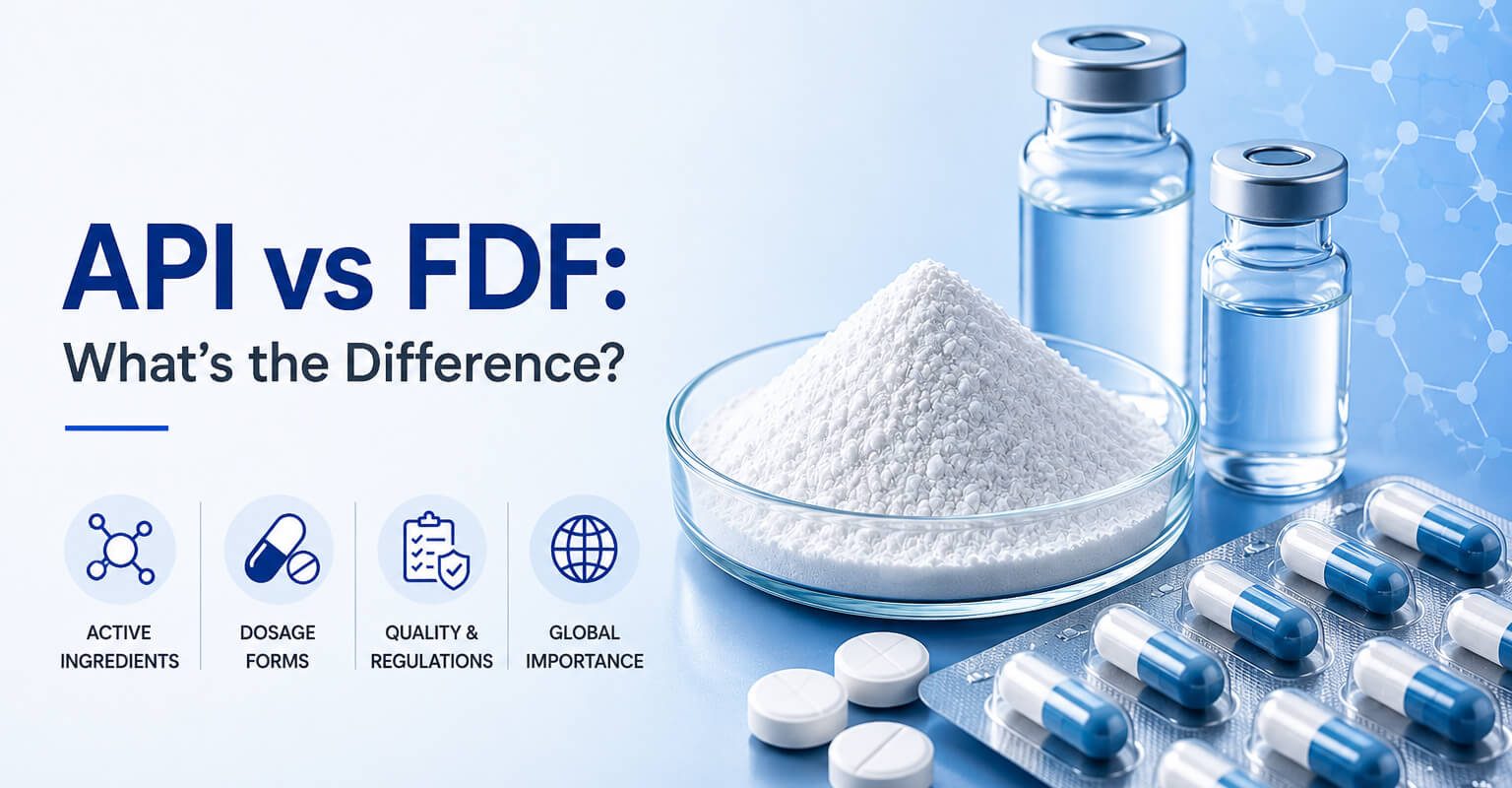
Two buyers can order the same medicine and receive completely different goods. One receives drums of white powder, the other cartons of blister-packed tablets.
An API is the active pharmaceutical ingredient — the molecule that produces the therapeutic effect. An FDF, or finished dosage form, is what the patient takes: the tablet, capsule, syrup or vial. Every FDF contains at least one API.
The API vs FDF difference changes which regulatory file you need, how goods are tested and priced, how long they can be stored, and which licence you import under.
Quick answer: An API is the pure active substance that gives a medicine its effect, produced by chemical or biological synthesis and sold in bulk by the kilogram. An FDF is the finished dosage form — tablet, capsule, injection or cream — made by blending that API with excipients and packing it for patient use.
Table of Contents
- What Is an API?
- What Is a Finished Dosage Form?
- Where Each Sits in the Supply Chain
- API vs FDF: The Core Comparison
- Excipients: Why an FDF Is More Than Its API
- The Main Dosage Forms
- API vs FDF: How Manufacturing Differs
- How Quality Testing Differs
- How Regulatory Filings Differ
- Pricing, MOQ and Commercial Terms
- Retest Date vs Expiry Date
- Packaging Differences
- API vs FDF: Which Should You Import?
- Expert Tips
- Common Mistakes
- Frequently Asked Questions
What Is an API?
An API is the substance in a medicine that does the therapeutic work. In a paracetamol tablet, the paracetamol is the API; everything else exists to deliver it.
APIs are made in dedicated chemical or biological plants as powders, crystals or granules, and supplied in bulk — kilograms to tonnes — in fibre drums or lined bags. Each is described by a pharmacopoeial standard, IP, BP, USP or EP, which sets its purity limits and test methods.
An API cannot be sold to a patient. It is an industrial input bought by formulators, and our complete guide to active pharmaceutical ingredients covers it in depth.
What Is a Finished Dosage Form?
A finished dosage form is the drug product in the form the patient uses, with a defined strength, a route of administration, and a label carrying dosing instructions.
An FDF sits at the end of the chain: formulated, processed, packed, labelled and released by an authorised signatory. It is regulated as a medicine, needs a marketing authorisation in the destination country, and must carry a label in that country’s language and format.
Where an API is judged on purity, an FDF is judged on performance — whether it releases the right amount of drug, at the right rate, in every unit of the batch.
Where Each Sits in the Supply Chain
The two occupy separate links in a predictable chain.
| Stage | Output |
|---|---|
| Key starting materials | KSM, intermediates |
| API manufacturing | Bulk API |
| Formulation | Tablets, capsules, vials |
| Packaging | Market-ready packs |
| Export | Product at the buyer |
Most companies operate at one or two of these stages. A dedicated API manufacturer rarely runs a compression line, and formulation plants buy their APIs in.
API vs FDF: The Core Comparison
This table is the short version. The sections below expand each row.
| Aspect | API (Active Pharmaceutical Ingredient) | FDF (Finished Dosage Form) |
|---|---|---|
| What it is | Pure active substance | Complete medicine for the patient |
| Physical form | Powder, crystals, granules | Tablet, capsule, syrup, injection, cream |
| Contains excipients | No | Yes, usually several |
| Regulatory file | DMF, CEP, ASMF | ANDA, MA, CTD dossier |
| Shelf-life marker | Retest date | Expiry date |
| Signature tests | Assay, related substances, residual solvents | Dissolution, uniformity of dosage units |
| Packaging | Drums, HDPE containers, lined bags | Blisters, bottles, ampoules, cartons |
Excipients: Why an FDF Is More Than Its API
A 500 mg paracetamol tablet does not weigh 500 mg. The rest is excipients, inactive ingredients with real functional jobs.
- Diluents bulk a small dose out into a tablet you can handle.
- Binders hold the granules together so the tablet does not crumble.
- Disintegrants make the tablet break apart in the stomach.
- Lubricants and glidants keep powder off the punches.
- Coating agents protect the API, mask taste, or delay release.
- Preservatives and buffers control microbial growth and pH in liquids.
Two products with the same API and strength can perform differently, because the formulation decides absorption. That is why generics need bioequivalence data rather than a matching ingredient list.
The Main Dosage Forms
The dosage form sets the process, the plant, the testing and often the price.
| Dosage Form | Examples | Buyer Considerations |
|---|---|---|
| Tablets | Plain, film-coated, enteric, sustained release | Lowest cost per dose, easy to ship |
| Capsules | Hard gelatin, HPMC, softgel | Check gelatin source for halal or vegetarian markets |
| Oral liquids | Syrups, suspensions, drops | Heavy and bulky freight |
| Injectables | Vials, ampoules, prefilled syringes | Highest regulatory burden, often cold chain |
| Topicals | Creams, ointments, gels | Transit temperature, tube compatibility |
| Inhalation | MDIs, DPIs, nebuliser solutions | Device performance is part of the product |
Injectables and inhalation products need higher-grade facilities and more validation. Tablets stay the workhorse of most export portfolios.
API vs FDF: How Manufacturing Differs
The two processes share little beyond both being GMP-regulated.
API manufacturing
API production is chemistry or biotechnology. A synthetic API is built through reaction steps from key starting materials, each followed by workup — extraction, crystallisation, filtration — with the final stages focused on purification.
Recrystallisation, drying, milling and sieving then bring the material to the required purity, particle size and polymorphic form. Biological APIs instead use fermentation or cell culture, then harvest, chromatographic purification and filtration.
Solvent handling and impurity management dominate. Change a solvent or a reaction temperature and the impurity profile shifts, which is what regulators scrutinise.
FDF manufacturing
Formulation is physical, not chemical. The API arrives already made; the job is to convert it into a reliable dose.
A tablet runs through dispensing, sifting, blending, granulation, drying, lubrication, compression, coating, then blistering and cartoning. Capsules replace compression with filling, liquids with mixing and bottle filling, and injectables add sterile suites, aseptic technique and often lyophilisation.
The critical controls are physical: blend uniformity, granule moisture, tablet hardness, weight variation and fill volume. Get these wrong and the patient gets the wrong dose from a perfect API.
How Quality Testing Differs
An API is tested to prove what it is and how pure it is. An FDF is tested to prove how it behaves as a dose.
| Test Category | API Testing | FDF Testing |
|---|---|---|
| Strength | Assay as % of pure substance | Assay as % of label claim |
| Impurities | Related substances, degradants | Related substances and formulation degradants |
| Solvents | Residual solvents by GC (ICH Q3C) | Usually not applicable |
| Physical | Particle size, polymorph, bulk density | Hardness, friability, weight variation |
| Release | Not applicable | Dissolution, disintegration |
| Dose consistency | Not applicable | Uniformity of dosage units |
| Sterile products | Only for sterile-grade APIs | Sterility, endotoxins, particulate matter |
Dissolution measures how much API is released over time, linking manufacturing quality to how the product behaves in a patient. Whichever you buy, the certificate of analysis is your evidence that the tests were run on your batch.
How Regulatory Filings Differ
The paperwork here is different in kind, and buyers often get it wrong.
For APIs, the manufacturer files data on the substance and its process: a US Drug Master File, a Certificate of Suitability (CEP) in Europe, or an Active Substance Master File in the EU system.
These files hold confidential process detail, so they go directly to the authority and the formulator only references them, a mechanism covered in drug master file explained for importers.
For FDFs, the applicant asks for permission to market a specific medicine — an ANDA in the United States, a marketing authorisation application in the EU, or a CTD or ACTD dossier across much of Asia and Africa.
That dossier includes the API information, usually by reference to the DMF or CEP, plus formulation, specification, stability data, packaging, labelling and bioequivalence data against the reference listed drug.
An API can ship to a licensed formulator on your import licence. An FDF cannot be sold until the product is registered locally, which takes months to years.
Pricing, MOQ and Commercial Terms
APIs are priced per kilogram, FDFs per unit. Comparing the two only means something once both are converted to cost per dose.
API minimum order quantities reflect batch economics: a small quantity still needs a full reactor cleaning and changeover, so short orders carry a steep premium.
FDF minimum order quantities are driven by machine setup, artwork and change-part costs. A printed carton for one market makes short runs expensive whatever the API costs.
| Commercial Factor | API | FDF |
|---|---|---|
| Price basis | Per kg | Per unit or pack |
| MOQ driver | Reactor batch size | Line setup and printed packaging |
| Price volatility | Higher, tracks solvent and KSM costs | Lower, API is one input among many |
| Lead time | Shorter if in stock | Longer where artwork or registration applies |
| Freight profile | Dense cargo, priced by weight | Bulky cargo, priced by volume |
For many older, high-volume molecules the API is a modest share of finished product cost, so chasing a lower API price rarely transforms your landed cost.
Retest Date vs Expiry Date
This nuance causes more documentation confusion than any other.
An FDF carries an expiry date. After it, the product must not be used. The date comes from stability studies on the finished product in its final pack.
An API typically carries a retest date. That is not an expiry. It is the date by which the material should be tested again against its specification; if it still complies, it can be used and a new retest date assigned.
A stable bulk substance in a sealed drum does not stop being acceptable on a calendar date; testing decides. Less stable APIs and most biologicals are given an expiry date instead, so check the COA rather than assuming.
The commercial effect is real. API stock past its retest date may still be usable; FDF stock past expiry is waste. Both rest on stability studies run under conditions matching the destination climatic zone.
Packaging Differences
API packaging is industrial and protective: fibre drums with double LDPE liners, HDPE containers, or triple-laminated aluminium bags, with desiccant where moisture is a risk. Labels carry the material name, batch number, quantity, manufacturing and retest dates, and storage conditions.
FDF packaging is patient-facing and regulated in detail. Primary packaging touches the product — blister foil, bottle, ampoule, tube. Secondary packaging carries the artwork, leaflet, batch coding and any serialisation required, and its approval is often the slowest step in an order.
Both follow pharmaceutical packaging standards that vary by market.
API vs FDF: Which Should You Import?
It comes down to what your business does and what your licence permits.
Import API if you own or contract a formulation facility, hold a manufacturing licence, or supply several markets from one base.
Import FDF if you are a distributor or tender supplier without manufacturing capability, need market-ready product quickly, or your volume does not justify a formulation run.
A middle path is widely used: import bulk finished product — unpacked tablets or capsules — and complete packaging locally. This cuts freight cost and gives artwork control, but needs a local packing licence.
Importing API only pays off at volume, because you take on formulation, waste, testing and the regulatory burden of the finished product yourself.
Check import rules first: some countries restrict API imports to licensed manufacturers, and most require registration before FDF imports begin. Your export documentation differs between the two routes.
Expert Tips
- Ask who makes the API before you order an FDF. A reputable formulator will name the API source and the regulatory file behind it.
- Match the pharmacopoeial standard to your market, not to price. If your dossier says BP, you need BP. Substituting after filing means a variation.
- Read particle size and polymorph on the API COA. Two batches can pass assay and still behave differently on a compression line.
- Confirm retest or expiry dating at the quotation stage. It changes how long you can hold stock and plan reorders.
- Start FDF artwork the day you place the order. Approval cycles routinely outlast production itself.
- Ask for dissolution data on FDFs, not just assay. A tablet can be on-assay and still release too slowly.
- Check climatic zone stability for hot or humid markets. A product supported only by Zone II data will struggle in much of Asia and Africa.
Common Mistakes
- Rejecting an API COA because it shows a retest date instead of an expiry. Delays release of a perfectly compliant batch.
- Requesting a DMF number for a finished product. DMFs cover substances, not drug products, so the request stalls the discussion.
- Assuming same API means same product. Two generics with identical actives can differ in release profile, and switching blind causes complaints.
- Importing FDF before local registration. The consignment sits at customs or is destroyed at the importer’s cost.
- Comparing API price per kg against FDF price per unit. Produces wrong margins and quotations you cannot honour.
- Ignoring excipient restrictions in the destination market. Gelatin capsules and some colourants are restricted in certain countries, and finding out late means rework.
- Ordering FDF without checking shelf life at arrival. Stock arriving with most of its life gone is hard to place in tender channels.
Frequently Asked Questions
What does FDF stand for in pharma?
FDF stands for finished dosage form — the drug product in the form a patient actually uses. That means a tablet, capsule, syrup, injection, cream or inhaler, complete with its excipients, packaging and label. The term separates it from the bulk active pharmaceutical ingredient, which is only one component of the finished product. Export paperwork also uses “drug product” or “finished formulation” for the same thing.
Is an API the same as a drug?
An API is the active substance that produces the therapeutic effect, but on its own it is an industrial raw material. It cannot be dispensed to a patient because it has no dose unit, no delivery system and no labelling. It becomes a drug only after being formulated with excipients, tested for release performance, packed and approved for sale. Regulators treat the two as separate categories with different filings.
Which is more expensive, API or FDF?
They are not directly comparable, because APIs are priced per kilogram and FDFs per unit. Converting both to cost per dose is the only fair comparison. For older high-volume molecules the API is often a modest share of finished product cost, with packaging, testing, regulatory upkeep and distribution making up the rest. Importing API becomes cheaper only at volumes large enough to absorb formulation and registration costs yourself.
Why do APIs have a retest date instead of an expiry date?
Because a stable bulk substance stored correctly in a sealed container does not become unacceptable on a fixed calendar date. The retest date is when the material should be tested again against its specification. If it complies, it can still be used and a new retest date is assigned. Finished products get an expiry date because formulation, packaging and dose unit age together. Some less stable APIs do carry expiry dates.
What are excipients and are they safe?
Excipients are the inactive ingredients in a finished dosage form — fillers, binders, disintegrants, lubricants, coatings, preservatives and buffers. Each has a functional job, from making a small dose handleable to controlling where in the gut the drug is released. They are pharmacopoeial-grade materials with their own specifications and testing, and use levels are set in regulatory guidance. Some, such as animal-derived gelatin, are restricted in particular markets.
Can I import API without a manufacturing licence?
In most regulated markets, no. APIs are usually restricted to licensed pharmaceutical manufacturers or to registered importers supplying them, because the material is only useful as a manufacturing input. Rules vary by country, and some jurisdictions also require the API manufacturer or site to be registered. Check your drug regulator’s import requirements first. If you do not hold a manufacturing licence, importing finished dosage forms is the practical route.
What is the difference between a DMF and an ANDA?
A Drug Master File covers an active substance. It holds confidential detail about the manufacturing process, controls and impurity profile, filed directly with the authority so a formulator can reference it without seeing inside. An ANDA is an Abbreviated New Drug Application — a request to market a specific generic finished product in the United States. It references the API’s DMF and adds formulation, specification, stability, packaging and bioequivalence data.
Can I buy bulk tablets and pack them locally?
Yes, and this is a common arrangement. Bulk finished product — coated or uncoated tablets, or filled capsules in bulk containers — ships without primary or secondary packaging, then gets blistered, cartoned and labelled at a licensed packing site in the destination country. It lowers freight costs and gives you control over artwork and pack sizes. You need a local packing licence covered in the product’s registration.
Final Thoughts
The API vs FDF question is really about where your business sits in the chain. If you manufacture, you buy substance. If you distribute, you buy product. The filings, tests, dates and pricing all follow from that.
Whichever you source, read the batch documentation against an agreed specification and confirm the supplier’s site status before the first shipment.
Work With a Supplier Who Handles Both
AksharAvira Pharma supplies both active pharmaceutical ingredients and finished dosage forms to international buyers, so we can compare the two routes for your molecule and market.
If you are weighing bulk API against finished product, discuss your sourcing requirements with our team.