
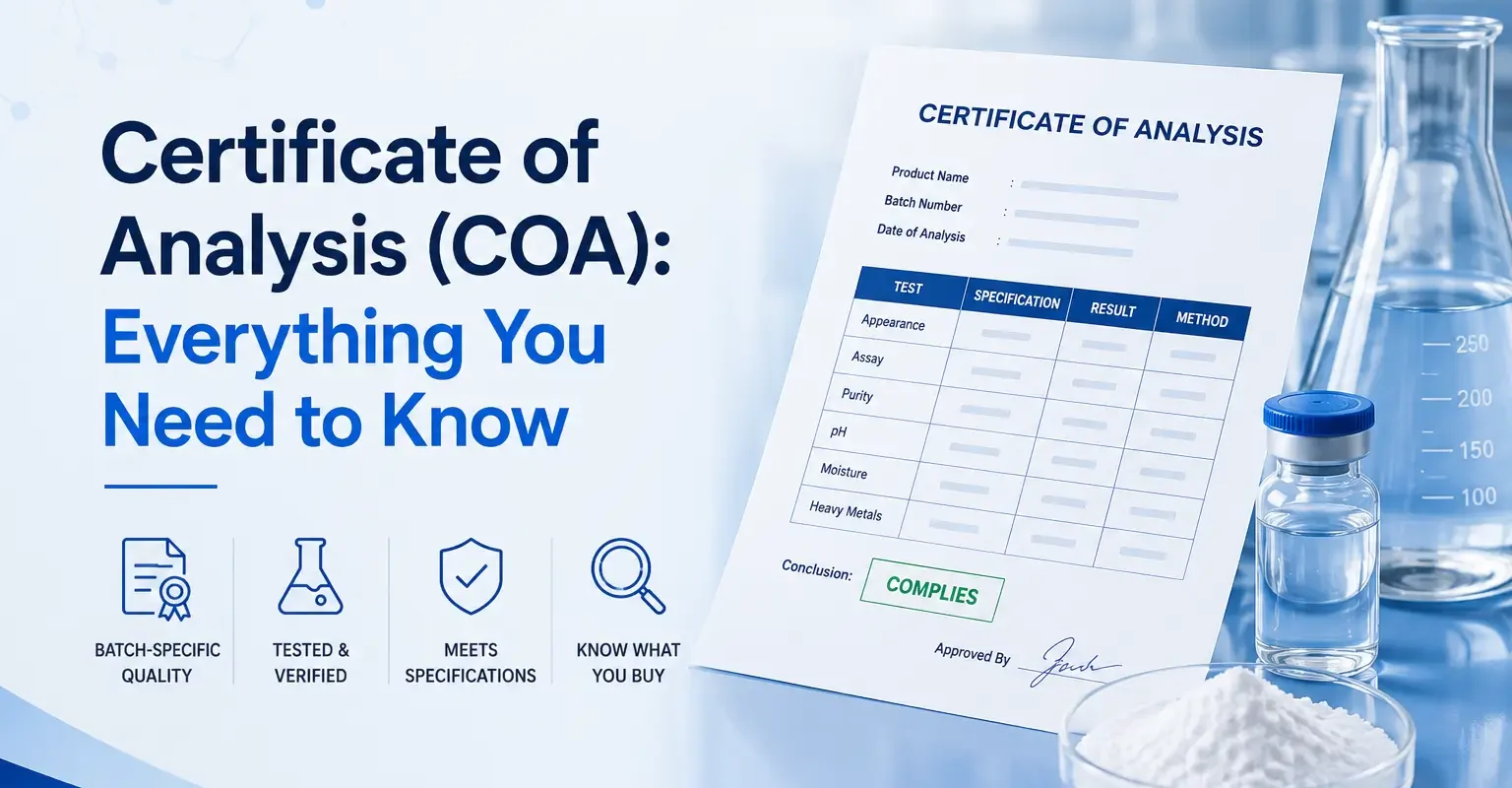
A Certificate of Analysis is the document that tells you whether a specific batch of material is fit to use. Not the product in general — that one batch, made on that date, tested by that laboratory.
Most buyers read them shallowly — product name, a glance at the assay, file the PDF. That is where problems start. If the batch later fails, the COA is the first document a regulator or customer asks to see, and it gets read line by line.
This guide covers what a COA represents, who signs it, every field on a proper one, how to check it against your own testing, and how it differs from the other export certificates.
Quick answer: A Certificate of Analysis (COA) is a batch-specific quality document issued by a manufacturer’s Quality Control laboratory and released by Quality Assurance. It lists each test performed on that batch, the specification limit, the analytical method used, and the actual result obtained, confirming the batch meets its approved specification.
Table of Contents
- What a Certificate of Analysis Legally Represents
- Who Issues and Signs a Certificate of Analysis
- Anatomy of a Certificate of Analysis: Field by Field
- Specification vs Method vs Result: How to Read the Three Columns
- An Illustrative Worked Example
- COA vs CoC vs CoPP vs Batch Release Certificate
- COA, In-House Specification, and the Pharmacopoeial Monograph
- How to Spot a Falsified or Copy-Pasted COA
- Why You Verify a COA Against Your Own Incoming Testing
- Retention Samples: The Physical Backup to the Paper
- How COAs Are Used in Customs and Regulatory Submissions
- Expert Tips
- Common Mistakes
- Frequently Asked Questions
What a Certificate of Analysis Legally Represents
A COA is a formal declaration by the manufacturer that a named batch was tested against an approved specification and met it. Signed evidence, not a sales document.
The key word is batch. A COA covers one lot of material with one manufacturing date and one set of results. It says nothing about the batch made the week before.
In most jurisdictions it forms part of the GMP record, sitting alongside the batch manufacturing record and the analytical raw data. An inspector can trace any number on it back to an instrument printout.
That traceability is what makes it meaningful. A result that cannot be traced to raw data is a claim, not a result. For the quality system behind it, see GMP, WHO-GMP, EU GMP and US FDA.
Who Issues and Signs a Certificate of Analysis
The manufacturer’s Quality Control laboratory performs the testing and records the results. Quality Assurance then reviews and signs the batch for release — typically a QA head or another authorised person named in the quality system.
QC produces data; QA authorises the batch. Two signatures with dates are common on a well-built COA.
Traders and distributors sometimes issue their own COA. That is acceptable only when the original manufacturer’s COA is attached and the two agree. If you are still assessing the supplier, see what buyers should check before choosing an API supplier.
Anatomy of a Certificate of Analysis: Field by Field
A proper COA follows a predictable order. Here is what each field means and what to check.
Header block
- Manufacturer name, address, and site. The physical manufacturing address, not the corporate office. Check it against the GMP certificate.
- Product name and grade. Should match your purchase order exactly, including the grade — “Paracetamol IP/BP”, not just “Paracetamol”.
- Batch or lot number. Must match the drum labels, invoice, and packing list. A mismatch stops the goods at the warehouse door.
- Batch size or quantity. A 5 kg shipment against a 2,000 kg batch is normal; a batch smaller than your order is not.
- Manufacturing date. When the batch was completed. This anchors the shelf life.
- Retest date or expiry date. APIs usually carry a retest date, so material can be re-tested and used beyond it if it still complies. Finished products carry a final expiry date.
- Date of analysis and date of release. When testing finished, and when QA authorised the batch.
- Pharmacopoeial reference. The standard applied — IP, BP, EP, USP, JP — ideally with the edition. Every specification below is measured against it.
Test result block
The body of the certificate, normally a four-column table: Test — Specification — Method — Result.
- Appearance or description. A visual check, such as “white or almost white crystalline powder”. Gross problems show here first.
- Identification. Confirms the material is what the label says, usually by two techniques — infrared spectroscopy against a reference standard, plus HPLC retention time.
- Assay. The percentage of active substance, by HPLC or titration, on a dried or anhydrous basis. The headline number most buyers look at.
- Related substances. Named impurities, the unspecified impurity limit, and total impurities. This tells you more about process control than the assay does.
- Residual solvents. Solvents left from synthesis, tested by gas chromatography against ICH Q3C class limits.
- Water content or loss on drying. By Karl Fischer titration or oven drying. Water affects stability and the true assay value.
- Sulphated ash or residue on ignition. Inorganic residue left after burning the sample.
- Heavy metals and elemental impurities. Modern monographs apply ICH Q3D limits by ICP-MS or ICP-OES, replacing the older wet heavy-metals test.
- Microbial limits. Total aerobic count, yeast and mould count, and absence of specified organisms such as E. coli or Salmonella, where required.
- Particle size distribution. Usually d10, d50 and d90 values. It affects dissolution, blend uniformity, and flow in the tablet press.
- Other physical tests. Bulk density, pH of solution, optical rotation, melting range, and clarity of solution.
Footer block
- Overall conclusion, such as “The batch complies with IP/BP specification.”
- Storage conditions, packing, and remarks — temperature, container type, pack count, and any deviation note.
- QA release signature. Name, designation, signature, and date. An unsigned COA is a draft, whatever it says at the top.
Specification vs Method vs Result: How to Read the Three Columns
Buyers often read only the result column. The other two carry more information.
Specification is the acceptance limit the batch had to fall inside, taken from the monograph, the in-house specification, or your own contractual requirement.
Method is how the test was performed. “As per BP” and “In-house HPLC method AV/QC/001” are very different statements. A pharmacopoeial method is validated by the pharmacopoeia; an in-house method needs its own validation data.
Result is what the laboratory found. Real results are numbers. “Complies” is fine for qualitative tests like identification or appearance, but not for assay, water content, or impurities — you cannot tell whether the assay landed at 99.8% or scraped through at 98.1%. A batch sitting near the edge of specification behaves differently in production from one in the middle.
An Illustrative Worked Example
The table below is a generic, illustrative example only. The numbers are invented to teach the format and do not represent any real batch, supplier, or company.
It shows a COA for Paracetamol IP/BP, Batch No. PCM-0000-A, batch size 2,000 kg, manufactured March 2026, retest date March 2029.
| Test | Specification | Method | Result |
|---|---|---|---|
| Description | White crystalline powder | Visual | White crystalline powder |
| Identification A | IR matches reference standard | IR spectroscopy | Complies |
| Identification B | Retention time matches standard | HPLC | Complies |
| Assay (dried basis) | 99.0% – 101.0% | HPLC | 99.7% |
| 4-Aminophenol | Not more than 0.005% | HPLC | 0.002% |
| Any unspecified impurity | Not more than 0.10% | HPLC | 0.03% |
| Total impurities | Not more than 0.20% | HPLC | 0.07% |
| Residual solvents | Meets ICH Q3C limits | GC | Complies |
| Water content | Not more than 0.5% | Karl Fischer | 0.18% |
| Sulphated ash | Not more than 0.1% | Gravimetric | 0.04% |
| Elemental impurities | Meets ICH Q3D limits | ICP-MS | Complies |
| Total aerobic count | Not more than 1000 cfu/g | Plate count | 40 cfu/g |
| Particle size d90 | Not more than 200 µm | Laser diffraction | 165 µm |
Read across, not down: a row only means something when limit, method, and result are read together. Then read the pattern — every result here sits comfortably inside its limit, the profile you want repeated across three consecutive batches.
COA vs CoC vs CoPP vs Batch Release Certificate
These four documents get confused, and importers sometimes accept one when their market requires another.
| Feature | Certificate of Analysis (COA) | Certificate of Conformance (CoC) | Certificate of Pharmaceutical Product (CoPP) | Batch Release Certificate |
|---|---|---|---|---|
| What it states | Actual test results for one batch | That the batch conforms to specification | That the product is licensed and made under GMP in the exporting country | That a specific batch is authorised for sale or supply |
| Contains numbers? | Yes, test by test | No, a statement only | No | Usually references the COA rather than repeating it |
| Who issues it | Manufacturer’s QC/QA | Manufacturer, trader, or supplier | The national regulatory authority of the exporting country | Qualified Person, authorised person, or a national control laboratory |
| Scope | One batch | One batch or one delivery | The product, not a batch | One batch |
| Typical use | Incoming material acceptance, GMP records | Packaging materials, some excipients, non-critical items | Product registration in an importing country | Market release, especially in the EU and for vaccines |
| Legal weight for import | Almost always required | Rarely sufficient alone | Often mandatory for registration | Required in specific regulated markets |
In short: a COA proves the batch was tested, a CoC only asserts it was acceptable, a CoPP covers the product’s regulatory standing, and a batch release certificate authorises that batch onto the market. See also common documents required for pharmaceutical export.
COA, In-House Specification, and the Pharmacopoeial Monograph
Three documents sit behind every result, and they are not the same thing.
The pharmacopoeial monograph is the public standard published by IP, BP, EP, USP, or JP. It sets the minimum requirements for the material.
The in-house specification is the manufacturer’s own document. It must be at least as strict as the monograph, and often adds tests the monograph never mentions — particle size, bulk density, tighter impurity limits.
The Certificate of Analysis reports the batch against whichever specification was applied. It is the output, not the standard. This is why “complies with USP” is incomplete: ask which specification was used, and ask for a copy.
How to Spot a Falsified or Copy-Pasted COA
Falsified certificates exist, and most are recycled documents with fields changed. Watch for:
- Identical results across batches. Three batches reporting an assay of exactly 99.62% with matching impurity values were copied. Real results vary.
- Impossible or absent dates. An analysis date before the manufacturing date, or no date beside a signature.
- Mismatched batch numbers between the header, the footer, and the file name — the most common giveaway on edited PDFs.
- Visual inconsistencies. Mismatched fonts inside the results table, or a signature image pasted at a different resolution.
- Results outside the stated limits, still marked as complying. Nobody reviewed the document.
- Tests missing for the stated pharmacopoeia, or vague method references such as “as per standard method” with no method number.
The reliable check is verification at source. Email the manufacturer’s QA department using contact details from their official site, not the ones printed on the suspect document. Our guide on how to verify a reliable pharmaceutical manufacturer covers the deeper checks.
Why You Verify a COA Against Your Own Incoming Testing
Accepting a supplier’s COA at face value is a shortcut you earn, not one you start with.
Regulated markets expect the receiving site to run at least an identification test on every incoming container, whatever the COA says. Beyond identity, most quality systems require full testing of the first batches from a new supplier.
Only after your results and theirs agree repeatedly can you reduce your own testing, and periodic re-testing continues after that. A COA describes material as it left the factory, and yours has travelled since.
Small consistent differences between your assay and theirs usually mean a method difference; sudden large gaps mean something changed. See quality control vs quality assurance for who does what.
Retention Samples: The Physical Backup to the Paper
A retention sample, also called a reserve or control sample, is a portion of the batch kept aside by the manufacturer in the original packaging under labelled storage conditions.
It must be large enough for full re-testing and is generally kept for a defined period past the expiry or retest date. Requirements vary between markets.
They exist so a question raised two years later can be answered with material, not memory. If a complaint or stability signal appears, the retained sample is re-tested against the original COA.
Ask suppliers whether they hold them and for how long — a supplier who cannot produce one cannot defend their own certificate. Our guide to stability studies in pharmaceuticals covers how retained material feeds shelf-life data.
How COAs Are Used in Customs and Regulatory Submissions
At the border, the COA supports the customs declaration by proving the consignment is what the invoice says. Many drug regulatory authorities require it before releasing a pharmaceutical import.
Some countries require the COA to be attested, legalised, or accompanied by a CoPP. Others require the importing agent’s own laboratory to test the consignment before it clears. Check your destination’s requirement before shipment.
In submissions, COAs appear in the quality section of a dossier as batch analysis data — usually for several consecutive batches, to show consistency rather than one good result. They also support validation reports, product quality reviews, and supplier qualification files.
Being asked during an audit for a COA from three years ago, and finding it in under a minute, says more about your quality system than any policy document.
Expert Tips
- Ask for three consecutive batch COAs, not one. One certificate shows a good batch. Three show a controlled process, and the spread between them tells you how tightly the manufacturer runs.
- Insist on numerical results for quantitative tests. Write it into your purchase specification. Suppliers who agree in writing rarely give trouble later.
- Check the retest date against your production plan. Material with eight months of retest life left is not the same proposition as material with thirty.
- Match the COA against the drum labels before unloading. Catching a batch number mismatch on the dock is far cheaper than catching it in quarantine.
- Request the in-house specification, not just the monograph reference. You cannot judge a result without knowing which limit it was judged against.
- Compare the site on the COA with the GMP certificate. Group companies often run several sites, and only some may be approved for your market.
- Archive COAs by batch number in a searchable system. Retrieval speed during an audit is a quality attribute in itself.
Common Mistakes
- Treating the COA as a marketing document. Skimming it means missing results sitting at the very edge of specification until a production problem appears.
- Confusing retest date with expiry date. Material gets discarded early, or worse, used past a genuine expiry.
- Accepting a trader’s certificate without the manufacturer’s original. You have no traceable link to the testing laboratory, which fails at the first audit.
- Skipping incoming identity testing because the COA looks good. A direct GMP deviation in most regulated markets, and a common inspection finding.
- Ignoring the method column. An unvalidated in-house method can produce results your own laboratory cannot reproduce.
- Filing COAs by supplier instead of by batch. When a complaint names a batch number, the file becomes unusable exactly when you need it.
- Assuming a CoPP or Certificate of Conformance replaces a COA. The consignment is held at customs, and the delay costs more than the testing would have.
Frequently Asked Questions
What is a Certificate of Analysis in pharmaceuticals?
A Certificate of Analysis is a batch-specific document from the manufacturer confirming that one batch was tested against an approved specification and met it. It lists each test, the acceptance limit, the analytical method, and the actual result. Quality Control generates the data and Quality Assurance signs the release. It covers only the batch named on it, not the product in general, and forms part of the manufacturer’s GMP records.
Who issues a Certificate of Analysis?
The manufacturer issues it. Testing is done by the site’s Quality Control laboratory, and the certificate is reviewed and signed for release by Quality Assurance, usually a QA head or another authorised person named in the quality system. Traders sometimes issue their own version, which is acceptable only when the original manufacturer’s certificate is attached and the results agree. Otherwise you have no traceable link to the testing laboratory.
What is the difference between a COA and a Certificate of Conformance?
A Certificate of Analysis reports actual test results, test by test, with limits and methods shown. A Certificate of Conformance only states that the batch conforms to its specification, with no numbers behind it. A CoC is common for packaging materials and other non-critical items. For APIs and finished pharmaceutical products a CoC alone is rarely sufficient, and most regulatory authorities will ask for the full COA.
What is the difference between a retest date and an expiry date on a COA?
A retest date, used mainly for APIs, is the date by which the material should be re-tested. If it still meets specification it can usually be used for a further defined period. An expiry date, used for finished dosage forms, is final and the product must not be used after it. Confusing the two means usable material is scrapped, or expired product is released.
How can I tell if a Certificate of Analysis is fake?
Look for identical results repeated across different batch numbers, dates that do not make sense, batch numbers differing between the header and the drum labels, mismatched fonts inside the results table, and pasted signature images. Missing tests that the stated pharmacopoeia requires are another signal. The reliable check is direct verification: contact the manufacturer’s Quality Assurance department using details from their official website.
Do I still need to test material if the supplier sends a COA?
Yes. Regulated markets generally require the receiving site to perform at least an identification test on incoming containers, whatever the certificate says. Full testing is normally expected for the first batches from a new supplier, and only after repeated agreement between your results and theirs can testing be reduced. A certificate describes material as it left the factory, and shipping conditions can change what arrives.
Is a COA the same as a batch release certificate?
No. A Certificate of Analysis reports the analytical results for a batch. A batch release certificate is the formal authorisation allowing that batch onto the market, issued by a Qualified Person, an authorised person, or in some cases a national control laboratory. It normally references the COA rather than repeating its numbers. Some markets, particularly in the EU and for vaccines, require both documents.
What is a CoPP and when do I need one?
A Certificate of Pharmaceutical Product is issued in the WHO format by the national regulatory authority of the exporting country. It confirms the product is licensed there and manufactured under GMP conditions. Unlike a COA it describes the product and its regulatory standing rather than a specific batch. Many importing countries require a CoPP for registration or import licensing, so check your destination’s requirement before shipment.
Final Thoughts
The Certificate of Analysis is the most-handled and least-read document in pharmaceutical trade. Reading it properly costs a few minutes and prevents problems that cost a shipment.
Treat it as evidence you are entitled to question. Ask which specification was applied, ask for numbers instead of “complies”, and check it against material you have tested yourself.
Discuss Your Sourcing Requirements
AksharAvira Pharma supplies APIs, generics, and finished dosage forms to buyers in regulated and semi-regulated markets. If you need to review specifications, batch documentation, or market-specific certificate requirements, speak with our pharmaceutical experts.